
Completed Bachelor Theses
-
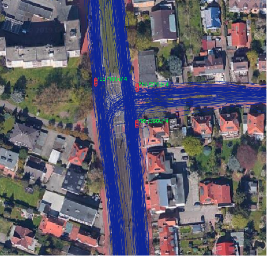
Trajectory modelingWith global navigation satellite systems and their free positioning services, as well as small, low-cost GNSS receivers, it's never been easier to capture and record motion anywhere, anytime. The resulting data volumes can quickly become very large. This makes these records impractical when it comes to storage and evaluation. Approaches to reduce the amount of data while preserving a maximum of spatio-temporal information are required.Led by: Colin FischerTeam:Year: 2016Duration: 2016
![]()
![]()


Completed Master Theses
-
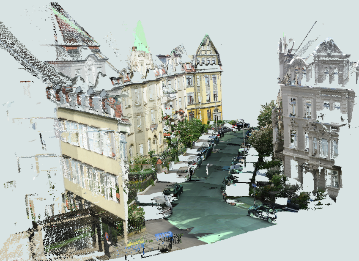
Integration of various data into a 3D voxel based Urban Digital TwinUrban environments are increasingly shaped by advanced digital technologies and demand dynamic, data-rich platforms for managing complex city systems. Urban Digital Twins (UDTs) enable comprehensive analysis and intelligent decision-making but face challenges integrating diverse geospatial data like Mobile Laser Scanning (MLS) point clouds, CityGML models, and Digital Terrain Models (DTM) due to differences in data type, precision, and semantics. Overcoming these inconsistencies is essential for accurate and actionable urban representations. In this thesis, a robust framework for the systematic integration of heterogeneous 3D geospatial data like (MLS) point clouds, CityGML LOD2 models, and DTMs into a unified voxel-based UDT was developed. The primary objective was to enhance geometric accuracy and semantic richness using a voxel-based integration approach to overcome inconsistencies in default data formats. The methodology involved semi-automated pipelines for aligning MLS with CityGML, refining DTMs using MLS and CityGML, and integrating all datasets into a voxel structure within a spatial database (PostGIS). Experiments on a test area in Hannover demonstrated improved positional accuracy after alignment, enhanced terrain models, and the preservation of geometric and semantic information within the integrated voxel UDT, enabling multi-source 3D urban analysis and visualization.Led by: ShkedovaTeam:Year: 2025
![]()
![]()
-
Development of a cross-domain calibration for use on LiDAR and camera sensors on mobile mapping systemsMobile mapping has been popularized over the last few years with special interest for re- search purposes. In this context, the Institute of Cartography and Geoinformatics (IKG) has developed a custom mobile mapping bike, equipped with two cameras and two Light Detection and Ranging (LiDAR) sensors, all connected to a Latte Panda Sigma com- puter. Due to the self-constructed setup, the geometric relationships between the sensors are initially unknown. Consequently, the aim of this thesis is to implement a workflow for determining the relative orientation between the sensors and to leverage the results for a visual validation through point cloud colorization using camera imagery. To establish the cross-sensor relations, orthogonal trihedrons are used as calibration tar- gets. The normal vectors from each planar surface are used as features to estimate the rotations alignment, where as the intersection point of all three planes is used to calculate the translation. For the plane extraction in the images, Augmented Reality University of Cordoba (ArUco) markers are used, where as Random Sample Consensus (RANSAC) is applied to the point cloud data. The core algorithm used to determine the relative orientation is the Kabsch algorithm, which is based on singular value decomposition. The initial calibration is further refined with a tracking-based approach, incorporating addi- tional measurements and model fitting to enhance accuracy and stability. Calibration results with a positional error of 2.052 cm in 2 m distance and an angular error of 0.0660° could be archived. After inspecting the colorized point cloud, a non-linear error propagation could be detected, suggesting that further improvements for the camera calibration are necessary. Moreover, different target patterns are advised to minimize their effect on the LiDAR measurements accuracy.Led by: Brenner, Wage, SchimanskyTeam:Year: 2025
![cros-domain calibration]()
![cros-domain calibration]()
-
Analysis of 3D City Data Regarding SubtainabilityClimate change and rapid urbanization are intensifying heat stress in cities, raising concerns for public health and urban livability. This thesis examines how 3D geospatial data and shadow analysis can be applied to assess urban microclimates and enhance pedestrian comfort, focusing on the Linden-Nord district of Hannover, Germany. Utilizing mobile mapping point clouds, 3D building models, and a digital terrain model, a digital surface model was generated to simulate solar radiation for a representative summer day (25th July 2025). Shadow analysis from solar radiation was conducted in ArcGIS Pro to quantify shading patterns and their impacts, while also visualizing areas with higher and lower solar radiation potential. The results revealed clear temporal and spatial variations: radiation increased from morning to a midday peak before declining in the afternoon. The analysis quantified the shading contributions of trees, buildings, and their combined effects, showing that buildings accounted for the largest share, whereas trees offered a smaller but consistent contribution. Although thresholding in shadow delineation introduced some uncertainty, the overall balance between shadow cast by buildings and trees remained robust. To further support outdoor comfort, a radiation-based shortest path analysis was implemented through network analysis in ArcGIS Pro. The routing results demonstrated that shaded paths are feasible and adaptable to the time of day and the distribution of urban features. Although longer than the shortest path, these shaded routes provided substantial reductions in solar exposure, in some cases exceeding 50%, depending on the time of day and the specific origin-destination pair. The study underscores the complementary role of built structures and vegetation in shaping urban microclimates and demonstrates the potential of shadow-based routing to enhance pedestrian comfort. These findings offer practical insights for sustainable urban design and heat-resilient mobility planning.Led by: Sester, Thiemann, GolzeTeam:Year: 2025
![Shadowmap]()
![Shadowmap]()
-
Async LUMPI: a time-asynchronized benchmark for cooperative object detectionCooperative perception, by intelligently integrating data from multiple agents, provides a comprehensive and accurate understanding of the surrounding environment and objects. In this work, cooperative perception is employed for 3D object detection tasks. Existing multi-modal datasets typically timestamp data based on frames, while objects are annotated based on LiDAR point clouds, leading to temporal discrepancies between annotations and frames. This temporal offset is more pronounced in cooperative perception datasets, as the measurements from LiDAR sensors on different agents are asynchronous. The same object may be captured by multiple sensors at different times. However, existing cooperative perception algorithms based on such datasets often overlook this temporal misalignment, resulting in significant errors. Hence, a new benchmark is proposed to address this issue, integrating asynchronous data with detailed timestamps to produce globally synchronized detection results. In this work, the asynchronous point cloud data with detailed timestamps, is provided by a multi-view, intersection dataset, LUMPI dataset. Additionally, annotations in the LUMPI dataset are globally synchronized through interpolation and serve as training and testing targets. Leveraging this new benchmark, a model is developed to utilize the asynchronous data and timestamps in the LUMPI dataset through cooperative perception, enabling the perception of temporal information within single frames and generating accurate globally synchronized timestamps.Led by: YuanTeam:Year: 2024
-
Query-based Semi-automatic Annotation for Cooperative Vulnerable Road User DetectionIn this study, a temporal modeling framework with multi-modality is introduced. Features are extracted from cameras and LiDARs, subsequently transforming them into the Bird's Eye View (BEV) space. This process captures the semantic information from cameras and localization data from LiDARs. A feature queue is designed to retain features from historical frames. The transformer facilitates temporal interaction between the feature queue and the current frame. The model demonstrates significant enhancements in pedestrian detection performance compared to the baseline model, which lacks temporal modeling and only relies on LiDAR information. The final feature passes through an anchor-based head to generate the final prediction. On the LUMPI dataset, an Average Precision (AP) of 95.0 is achieved by the model with an Intersection over Union (IoU) threshold of 0.3, and 77.7 with an IoU of 0.7.Led by: YuanTeam:Year: 2024
-
Localization correction using predicted objects and road geometry for collective perceptionThis study proposes a location correction method based on object detection and road segmentation. By employing the deep learning network GEVBEV, the LiDAR point cloud data collected by different vehicles is converted into 2D bounding boxes and road object segmentation results from a BEV (Bird’s Eye View) perspective. Subsequently, a road geometry is obtained using a route extraction method based on the segmentation results, while certain outliers are eliminated. The road geometry and detected objects serve as features, and the positioning errors between vehicles are corrected through two steps: coarse registration and precise registration. This approach enhances the collaborative perception performance among vehicles.Led by: YuanTeam:Year: 2024
-
Evaluation of SLAM algorithms for a bicycle LiDAR mobile mapping systemThis thesis evaluates SLAM algorithms for a LiDAR-equipped bicycle mapping system. The goal is to adapt various SLAM packages to the system, assess their performance, and compare results with reference data. Tasks include calibrating the system, compensating for motion, and integrating navigation data. Resources include access to the mapping platform and datasets. Proficiency in Python and experience with point clouds are required. The research aims to benchmark SLAM performance for bicycle mapping.Led by: SchimanskyTeam:Year: 2024
-
Occupancy-free Space Modeling and Navigation Path Planning in a 3D Voxel Grid Environment for Urban Digital Twin ApplicationsThrough the integration of various sensor data into smart city systems, urban digital twin technology plays a crucial role in advancing smart city technologies. Three-dimensional (3D) geospatial data forms the foundation for modeling and operating urban digital twins, enabling tasks such as intelligent space management and navigation. The aim of the master thesis is to model the static urban environment using a 3D voxel grid and represent unoccupied spaces with an octree structure for navigation within urban environments. The primary objective is to develop an efficient method to define free spaces within urban areas, which can be used as a graphical representation for implementing the shortest path algorithm, thereby supporting collision-free 3D navigation. The feasibility of this approach is demonstrated by visualizing the unoccupied spaces and their optimized navigation paths. By improving the efficiency and accuracy of path planning, this research contributes to the advancement of urban digital twin applications, thereby enhancing urban traffic management and efficiency.Led by: Shkedova, FeuerhakeTeam:Year: 2024
![Occupancy-free space modeling]()
![Occupancy-free space modeling]()
-
Integrative Modelling of Aleatoric and Epistemic Uncertainties in LiDAR Data ClassificationIn this study, uncertainty quantification for semantic segmentation of LiDAR 3D point cloud data is explored. Aleatoric uncertainty is addressed through Logit-Sampling, using an extra output neuron and Monte Carlo Sampling for output distribution modeling. Epistemic uncertainty is tackled using a Deep Ensemble method, which estimates uncertainty from the variance in model predictions and analyzes the impact of model parameters via Mutual Information. The combination of Logit-Sampling models into an ensemble is proposed, alongside the introduction of a Fixed Dropout Ensemble to increase diversity. Findings suggest that Logit Sampling effectively handles aleatoric uncertainty, particularly in complex scenarios, while the Deep Ensemble approach provides superior epistemic uncertainty quantification and calibration, outperforming standard models. However, the Fixed Dropout Ensemble shows limited effectiveness in detecting out-of-distribution scenarios.Led by: ShojaeiTeam:Year: 2024
-
Localization of mobile objects in the Absence of GPS/GNSS: A Hybrid 2D-3D ApproachIn today's dynamic landscape of autonomous vehicles and robotics, accurate and real-time localization is imperative. While 3D methods have been employed for vehicle localization, their time-consuming nature poses challenges. This research seeks to a novel hybrid approach, bridging the efficiency of 2D methods with the precision of 3D refinement, to offer a faster and more robust solution for vehicle localization. The primary goal is to investigate and implement a localization method leveraging 2D elevation models and BEV image as well, generated from point clouds acquired by a Mobile Mapping System (MMS) as the map. Additionally, point clouds from various sensors, including LiDAR, will be employed for localization. The methodology initiates rough vehicle localization through feature matching in 2D space, followed by a refinement process in 3D space.This integrated approach is designed to not only expedite the localization process but also enhance accuracy and precision, particularly in challenging environments where GPS/GNSS data is unavailable.Led by: MortazaviTeam:Year: 2024
-
Enhancing Point Cloud Localization with Adaptive Weighting Using Classified/Segmented DataThis study focuses on improving point cloud-based localization by developing an adaptive weighting algorithm. The research addresses challenges in dynamic environments by classifying point cloud data into semantic categories, such as static and dynamic objects, and adjusting the localization weights accordingly. The adaptive approach enhances accuracy by prioritizing stable environmental features and reducing the influence of dynamic elements. The work involves point cloud classification, adaptive weighting implementation, and performance evaluation using iterative closest point (ICP) algorithms, with a focus on benchmarking against traditional geometric methods.Led by: MortazaviTeam:Year: 2024
-
Monitoring and Optimization of Well Stimulation and Well Enhancement Techniques for Geothermal Applications Using Acoustic Emission and AI-Based MethodsGeothermal energy systems rely on drilling wellbores to access renewable energy resources beneath the Earth's surface. After drilling, well enhancement techniques are employed to stimulate the geothermal reservoir and improve its productivity. This research focuses on monitoring micro-drilling methods, particularly high-pressure jetting, using artificial intelligence methods to enhance geothermal reservoir performance and stimulation. Radial Jet Drilling (RJD) is an unconventional stimulation technique that utilizes high-pressure fluids to create lateral holes from existing vertical bores, increasing well injectivity or productivity. The thesis aimed to develop a framework for monitoring and optimizing wellbore stimulation and enhancement processes using Acoustic Emission and Machine Learning (ML) techniques. The proposed approach employed Autoencoders of 1D Convolutional layers for raw signal and Autoencoders of dense layers for down sampled signals for feature extraction from vibrational signals, combined with RJD process parameters to predict the volume of rock removed during the jetting process.Led by: SesterTeam:Year: 2024
-
Traffic Participant Behavior Prediction based on Dynamic Graph Neural NetworkVehicle trajectory prediction is crucial for intelligent transportation systems (ITS) to improve traffic efficiency, alleviate congestion, and enhance safety. Despite advancements in deep learning, trajectory prediction faces challenges due to dynamic agent interactions and complex traffic environments. Traditional rasterized approaches suffer from high computational costs and information loss, prompting a shift towards vectorized methods that use Graph Neural Networks (GNNs) for better feature learning and robustness. We propose a lightweight model using dynamic graph neural networks (DGNN) to improve efficiency, interpretability, and accuracy. Evaluated on the Argoverse 2 dataset, our approach demonstrates reduced computational time, lower parameter count, and high prediction accuracy compared to baseline models. Additionally, we explore a Detection Transformer (DETR)-basedLed by: XUTeam:Year: 2024
-
Uncertainty Estimation using Evidential Deep Learning in LiDAR Scene SegmentationThis study investigates the application of Evidential Deep Learning (EDL) for semantic segmentation and uncertainty estimation in point cloud data, moving beyond traditional softmax-based methods by utilizing a Dirichlet distribution framework. A novel loss function that combines Lovász loss, Sum of Squares loss, and KL divergence enhances the model's performance, achieving a significant increase in mean Intersection over Union (mIoU) from 56% to 59.6%. Through ablation studies and the use of transfer learning on the IKG LiDAR and IKG Mobile Mapping datasets, the work demonstrates the model's improved generalization and calibration. This research highlights the efficacy of EDL in providing robust, interpretable segmentation for real-world applications, particularly in autonomous driving and mapping.Led by: ShojaeiTeam:Year: 2024
-
Occupancy-free Space Modeling and Navigation Path Planning in a 3D Voxel Grid Environment for Urban Digital Twin ApplicationsThe urban digital twin is an innovative concept within smart city technology, aiming to develop integrated and intelligent systems by harnessing diverse data from a multitude of sensors. Three-dimensional (3D) geodata plays a pivotal role in the representation and operation of urban digital twins. Tasks such as smart space management and navigation have become increasingly essential in urban digital twin applications, and they can be effectively facilitated using a foundation of 3D geospatial data. Therefore, this master thesis focuses on the modeling of unoccupied space and navigation path planning, employing a 3D voxel grid environment representation. The objective of the thesis is to develop a suitable approach for defining vacant space within urban area, which is utilized to enable collision-free 3D navigation. To achieve this, it is proposed to integrate the point cloud data of the Hannover urban area into a 3D voxel grid structure. In this context, grid cells containing point cloud data are treated as obstacles, while unoccupied cells are collectively constitute the occupancy-free space. The identified vacant space serve as a graph for implementing the shortest path algorithm. Ultimately, both the occupancy-free space and an illustrative route through it are visualized to demonstrate the approach viability.Led by: Shkedova, FeuerhakeTeam:Year: 2023
![]()
![]()
-
Hololens 2 - Analysis of capabilities and qualityThe Hololens is a device, which captures information of the environment and creates a 3D model of it. At the same time, it is able to place virtual objects into the environment and thus allows AR-applications. The goal of the thesis is to investigate the potential of the Hololens for capturing indoor environments. This includes the acquisition of 3D point clouds and a thorough quality assessment. Subsequently, the point could has to be processed in order to segment important objects or features (e.g. walls, furniture). To this end, the use of Deep Learning models has to be considered.Led by: Kamalasanan, SesterYear: 2023
![]()
![]()
-
Future trajectory and Motion guidance with Augmented realityControlling pedestrian motion pattern using augmented reality would require explainable visualizations to convince the user to change directions and speed of motion. Such AR visualizations should avoid cognitive overload and should provide motion guidance that are accurate representations of expected user actions to avoid conflicts / collisions. The focus of this master thesis would be to design and evaluate 3D motion guidance augmentations using AR emphasizing how such visualizations can avoid collisions between pedestrian / smartphone zombie. The student is expected to design and validate motion guidance visualizations in augmented realityLed by: Kamalasanan, SesterYear: 2023
![]()
![]()
-
Development of an approach for integrating various format data into a 3D voxel-based Urban Digital twinThe advancements in instruments and methodologies for collecting, transmitting, analyzing, and representing three-dimensional (3D) geodata over the past few decades have opened up extensive possibilities for various applications. 3D geoinformation plays a pivotal role in the operational frameworks of Smart City technology that can be represented within an Urban Digital Twin concept. This involves utilizing diverse data from numerous sensors and designing an adaptive digital model that learns from and evolves alongside the real city.Led by: Shkedova, Feuerhake, SesterYear: 2023
![]()
![]()
-
Identification and analysis of movement patterns in trajectoriesIn this work, movement patterns in trajectory datasets are identified with respect to the respective visited locations of a trajectory. For this purpose, further semantic information is assigned to the whereabouts points depending on the position, time of day, and duration of stay; the assignment of semantic information with respect to position is done using OpenStreetMap data. Another focus was on the identification of related trajectory segments, since the given dataset was anonymized as a consequence of data protection; for this purpose, coordinate prediction was performed for all trajectory endpoints in order to identify a suitable continuing starting point of another trajectory using a proximity search and temporal proximity. Recurrent motion pattern detection performed based on the whereabouts points does not produce meaningful patterns detected in multiple trajectories throughout the dataset for the datasets used; however, meaningful recurrent patterns are found for individual trajectories. An increasing level of detail in assigning categories with respect to whereabouts results in fewer recurring patterns, which, on the other hand, allow for greater meaningfulness given the interpretation of an observed person’s movement behavior.Led by: Golze, Feuerhake, Wage, SesterTeam:Year: 2022
-
Development of a modular sensor platform for mobile detection of vehicle encountersRiding a bike in a shared traffic area with motor vehicles causes discomfort for many bicyclists. Avoiding busy roads is only possible with good local knowledge, as no data is available on the frequency of encounters with motor vehicles on most roads. Acquiring a dataset that collects smartphone sensor data on vehicle encounters could become the basis for a smartphone-based vehicle detector. Magnetometer and barometer readings are used as indicators of passing vehicles. In this thesis, a sensor platform is first constructed to collect smartphone and other sensor data while driving. The system is designed to be used with other sensor configurations in the future. A methodology is then presented to create a dataset of vehicle encounters based on data from a camera and a distance sensor on the sensor platform. This data set contains all important sensor data of a commercially available smartphone including the timestamp of vehicle encounters. Finally, a three-class classifier is trained and evaluated based on the data set. It is investigated which approach can provide a generalizable classifier. Approaches based on Random Forests are investigated for the classifier. The structure and parameters of a sliding window function are adjusted for feature generation.Led by: Wage, Feuerhake, Golze, SesterTeam:Year: 2022
![]()
![]()
-
Hololens 2 – Evaluating 3D Mapping and Technical CapabilitiesIn this study, the technical and 3D mapping capabilities of Hololens 2 was evaluated. The Microsoft Hololens 2 is a head-worn mobile mixed reality device that is capable of mapping its direct environment in real time. It is equipped with different sensors including four visible light tracking cameras and a depth sensor. The 3D map created using these sensor streams can be accessed by research mode. This makes Hololens 2 a powerful tool for mapping an indoor space. In this work, we evaluate the capabilities of Hololens 2 with respect to the task of the 3D indoor mapping, semantic segmentation and 3D modelling as the quality of scanned data highly influences the accuracy of reconstruction and segmentation.Led by: Vinu Kamalasanan, Monika SesterTeam:Year: 2022
![]()
![]()
-
Nutzungsdatengetriebene Analyse des Potentials von MikromobilitätsdienstenDer geteilten Mobilität wird in der öffentlichen Debatte um die Verkehrswende häufig eine entscheidende Rolle zugeordnet. Darunter fallen auch die sogenannten Mikromobilitätsdienste. Das Ziel dieser Masterarbeit ist es, das Potential von Mikromobilitätsdiensten für die Verkehrswende im Hinblick auf die Intentionen der Nutzer, auf zeitliche Variationen, sowie auf Vorteile gegenüber anderen Transportmitteln datenbasiert zu bewerten. Dafür wird eine Fallstudie anhand von Mobilitätsdaten der Bikesharing-Fahrräder und Elektrotretroller zweier Anbieter in Hannover durchgeführt.Led by: Wage, Feuerhake, GolzeTeam:Year: 2022
![]()
![]()
-
Comparison of network representations for analysing temporal power plant dataAs renewable energy is increasingly used in power generation, the temporal and spatial balance of electric power supply and demand requires large-scale power transmission to maintain. Describing such systems requires network modeling theory. This dissertation takes the German power transmission network as an example and explores the impact of different representations. The representation forms include unweighted network, weighted network, multiplex network and interconnected network. In this dissertation, the static topological characteristics of networks under different representations are examined. Then, the temporal data of the available capacity is also introduced, and a temporal network with the power flow path as the time variable is constructed based on Djikstra’s algorithm. In this research, we find that the weighted network is more suitable for modeling transmission networks than the unweighted network, and the multi-layer network may be more suitable for modeling more complex systems.Led by: Anna Malinovskaya, Philipp OttoTeam:Year: 2022
![]()
![]()
-
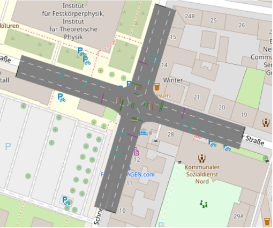
Trajectory Analysis at IntersectionsIn this thesis, we focus on trajectories at different intersections with various regulated types (traffic-light-controlled, priority/yield- controlled, uncontrolled) and test some methods to detect and recognise movement patterns, in terms of their geometrical and spatio-temporal components. That is, in the first case the geometric paths that vehicles follow while driving through the intersections and in the second case the way that they follow these geometric paths.Led by: ZourlidouTeam:Year: 2020
![]()
![]()
-
Trajectory anomaly detection using spectral clustering and RNN-based auto-encoderAnomaly detection is important, because anomalous behavior may indicate critical events or objects within diverse research areas and application domains. One of such domains is transport, especially integrated urban mobility. Trajectories of moving objects are good representations of their behaviors in surveillance data and useful in detecting anomalous behavior. On one hand, trajectories can provide more agent-based, long-term information comparing with simple physical features. On the other hand, comparing with raw video data, which is usually represented as a sequence of images, trajectory data requires less storage space and computational resources. Moreover, it has a wide variety of sources, such as GPS instruments and laser-scanners.Led by: Sester, KoetsierTeam:Year: 2020
![]()
![]()
-
Development of environmentally-balaced and congestion-avoiding routing algorithms by means of traffic simulationDue to the constantly growing volume of traffic in urban environments and the resulting problems such as increased air pollution, environmentally oriented approaches to achieve better urban sustainability of transport play an increasingly important role. This thesis deals with the development of environmentally-friendly routing algorithms and their validation in traffic simulations. The routing algorithm used is the A* - algorithm using the developed criteria as weights.Led by: Sester, FuestTeam:Year: 2019
![]()
![]()
-
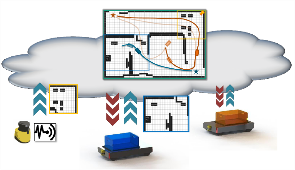
Development of a Client-Server Module for Cooperative Multi-Robot Longterm Map RegistrationNowadays a big amount of robots are used in production and logistic. Due to the large working environment, dynamic objects (e.g. humans or other robots), and semi-static objects (e.g.machine and furniture), a high performance navigation system is required. But only focus on the high performance long term SLAM on single robot is not enough to guarantee the flexible and accurate performance of whole robot fleet in large changing environment.Led by: Tobias Ortmaier (IMES), Claus Brenner, Steffen Busch (IKG), Philipp Schnattinger (FraunhoferIPA)Team:Year: 2019
![]()
![]()
-
Classification and detection of road users using neural networks and Active Shape modelsAutonomous vehicles interpret their environment based on their sensor data. 360° laser scanners provide comprehensive and highly accurate information about the distance of objects. Predicting the behavior of road users differs between cars, trucks/buses, cyclists and pedestrians. The exact position of the different road users depends on their orientation and geometric dimensions. Active Shape models offer the possibility to estimate the center of objects by estimating deformable models, based on CAD plans and taking into account their orientation.Led by: Bodo Rosenhahn (TNT), Claus Brenner, Steffen Busch (IKG)Team:Year: 2019
![]()
![]()
-
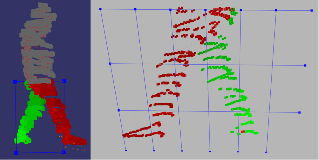
Laser scanner-based prediction of pedestrian movements by filtering and classifying postureAgainst the background of road safety, an algorithm is presented below that uses point clouds to make the most accurate prediction possible about the future position of pedestrians. A core element is to classify the current state of movement of pedestrians over a random forest. The focus is on early detection of changes between individual states.Led by: Claus Brenner, Steffen BuschTeam:Year: 2019
![]()
![]()
-
Travel Delay Analysis Using VISSIM and Pattern Recognition at Regulated JunctionsThis thesis explores the travel time and travel delay at T- and four-way junctions under different regulator settings (yield/priority traffic signs and uncontrolled junctions), conducting experiments both with simulation originated and real data. First this thesis uses VISSIM simulation software to estimate the delay and stop time at yield controlled and uncontrolled T- and and Four-way intersections. At the second part of the thesis, the same objective is being pursued by using real data.Led by: ZourlidouTeam:Year: 2019
![]()
![]()
-
Pattern Recognition of Movement Behavior for Intersection Classification using GPS Trace DataThe aim of this thesis is to classify different regulator types of traffic road intersections based on GPS trace data. To reach this aim a variety of features is calculated to describe the driving behavior at intersections. These are derived from the measured units of the GPS trace data that compose an individual’s movement trajectory.Led by: ZourlidouTeam:Year: 2019
![]()
![]()
-
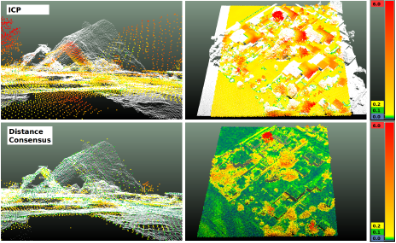
Robust registration of airborne point cloudsGoal of this thesis is the robust registration of airborne point clouds, which are derived from Airborne Laser Scanning (ALS) and Dense Image Matching (DIM). We implemented a coarse, translative registration method using a Maximum Consensus Estimator and compared our results with a standard ICP. In addition, we tested several methods to prune object points from point clouds, which are represented differently in both point cloud types.Led by: Politz, BrennerTeam:Year: 2019
![]()
![]()
-
Optimal assignment of point clouds using deep learningThe main goal of this master thesis was to register airborne 3D point clouds from different sensor systems. These point clouds are derived from airborne laser scanning (ALS) and dense image matching (DIM) of aerial images. Those point clouds may cover the same surface, but do contain different attributes and characteristics. One major problem when dealing with those two point clouds is vegetation. The laser beam in ALS is able to penetrate vegetation leading to ground and vegetation points in the final point cloud. Since they are derived from aerial images, DIM point clouds only contain the surfaces and thus describes the treetops. This major difference between ALS and DIM causes problems for the registration of point clouds and established algorithms such as the iterative closest points (ICP) algorithm are facing issues when dealing with both point cloud types at the same time, because they assume that similar points are close to each other.Led by: Brenner, PolitzTeam:Year: 2019
![]()
![]()
-
Klassifikation und Änderungsdetektion in Mobile Mapping LiDAR Punktwolken3D-Modelle der statischen Umgebung zu erstellen ist eine wichtige Aufgabe für das Voranbringen von Fahrerassistenzsystemen und dem autonomen Fahren. Hierzu stehen in dieser Arbeit Mobile Mapping LiDAR Punktwolken aus 14 Messepochen zur Verfügung, die mithilfe eines Voxel Grids zu einer Referenzkarte weiterverarbeitet werden. Ein Voxel Grid ist eine Datenstruktur, die den realen Raum in volumenhafte Elemente unterteilt und die Punktdichte der Punktwolken reduziert. Zusätzlich werden Daten aus einer Strahlverfolgung bereitgestellt, sodass zwischen durchschossenen und unbekannten Voxeln unterschieden werden kann, wodurch sich Verdeckungen erkennen lassen.Led by: Brenner, SchachtschneiderTeam:Year: 2019
![]()
![]()
-
Semi-Supervised Deep Learning for Object Detection in Airborne Laser Scanning DataThe main objective of this experiment is to compare the performance of Semi-Supervised Learning classification method and normal convolutional neural network classification method on Airborne Laser Scanning data (ALS) and find out the best suitable model that we can use to detect object in a large-scale region by using windows sliding approach. The data I used is digital terrain model (DTM) which generated by ALS point cloud and contains 4 different classes. In each class include 6 different visualization formats (digital terrain model, sky-view factor, local Dominance, positive-negative openness and simple local relief model) which use different visualization techniques to be generated from the original digital terrain model.Led by: KazimiTeam:Year: 2019
![]()
![]()
-
Deep Learning for Flood Relevant Images and Texts from Social MediaFloods are among Earth's most common and most destructive natural hazards. This work explores the idea of utilizing user-generated information from social media to recognize early signs of flood relevant events. The goal of this work lies in the development and implementation of a Deep Learning solution with the ability to detect the presence of flood relevant events from user-generated images and texts.Led by: Yu Feng, Prof. BrennerTeam:Year: 2018
![]()
![]()
-
Automatic enrichment of route instructions to form a cognitive mapCommonly used navigation instructions are based on metric turn descriptions (like "turn left onto Nienburger Straße in 100 m"). For the user it is easy to follow the course, but later it is hard to remember how s/he got there. Natural orientation is based on remarkable objects or locations called landmarks. Multiple of them are combined to the psychological model of a cognitive map, a network of landmarks and connecting actions. The resulting goal is to enhance the people's own sense of orientation by enriching common routing instruction with hints on landmarks. The automatic description of relevant landmarks along a route is implemented as a interactive web-map.Team:Year: 2017Duration: 2017
![]()
![]()
-
Gesture-based interaction with virtual 3D environmentsWith the availability of increasingly powerful computing technology in the home/leisure sector, a race to develop affordable virtual reality (VR) and augmented reality hardware broke out on the technology market a few years ago, targeting potential markets, in particular, for realistic 3D content presentation (e.g. computer games). The core of this technology is the processing of three-dimensional information in the form of 2D stereo image pairs, which can be consumed via suitable output hardware (glasses/helmets). However, this principle can also be used elsewhere, for example for better exploration of or interaction with 3D spatial data.Led by: Colin FischerTeam:Year: 2016Duration: 2016
![]()
![]()